Verbatik AI Review (2025): An Advanced Voice Recognition AI Platform
In this Verbatik AI review, we explore how this platform is redefining text-to-speech and voice automation through cutting-edge voice recognition AI technology. Verbatik AI enables users to create realistic, human-like voiceovers for videos, podcasts, and marketing content with minimal effort.
The platform offers a wide selection of natural-sounding voices across multiple languages and accents, allowing creators, educators, and businesses to generate professional audio instantly. Its user-friendly interface, speech editor, and cloud-based tools make it accessible to users without technical experience while maintaining studio-quality output.
Pros:
- Wide Voice Selection
- High-Quality Output
- Flexible Usage and Licensing
- Custom Voice Options
- Simple and Fast Interface
Cons:
- Limited Free Access
- Internet Dependence
- Occasional Pronunciation Errors
- No Offline Editing
Verbatik AI stands out as a reliable voice recognition AI platform, perfect for content creators, marketers, and businesses seeking high-quality, automated voice production without the complexity of traditional recording setups.
4.0
Average from 14 verified reviews
Pricing
Pro – $39 per month
Enterprise – $99 per month
About Verbatik AI
Verbatik AI is a highly regarded text-to-speech and voice synthesis platform, frequently recommended by content creators, educators, and businesses for its ability to generate lifelike audio in over 140 languages. Founded in 2021, the company has quickly grown into a trusted name in the AI voice technology space.
More than just a business, Verbatik AI is built around a global community of developers, marketers, and multimedia professionals. Their mission is to make high-quality voice generation accessible to everyone, empowering users to create engaging audio content for videos, podcasts, e-learning, and more.
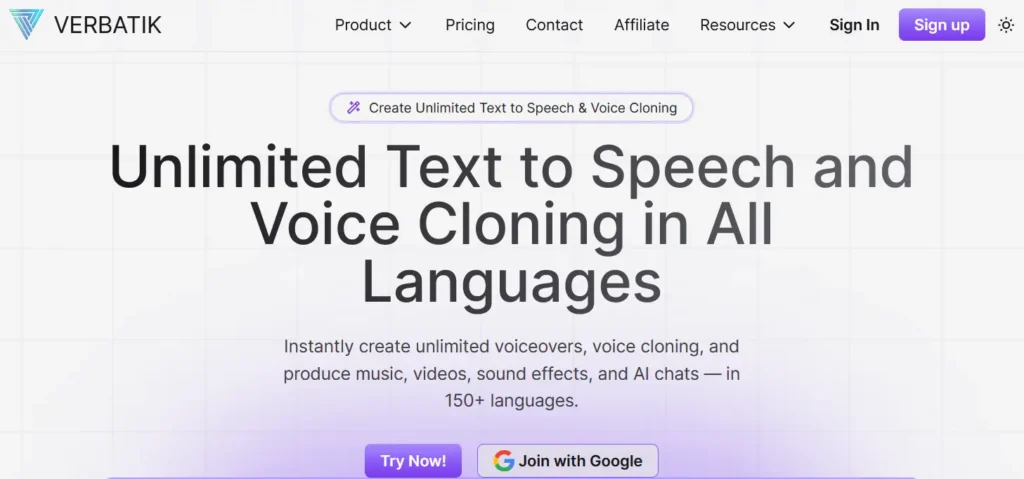
Initially, Verbatik AI offered basic text-to-speech conversion. Today, the platform provides a wide range of advanced features including voice cloning, avatar video generation, sound effects, and music creation. Users can manage projects through a customizable dashboard and export audio in MP3 or WAV formats—making it a versatile tool for both individuals and teams.
One of the reasons Verbatik AI continues to stand out in the competitive voice tech market is its flexible pricing. Users can start with a free trial and upgrade to premium plans based on their needs. The platform supports scalable usage for enterprises and offers regular updates to improve performance and expand capabilities.
Plus, every subscription comes with the freedom to cancel anytime. If you’re not satisfied with the results, simply discontinue your plan—no questions asked.
Key Features of Verbatik AI
AI Text-to-Speech Engine
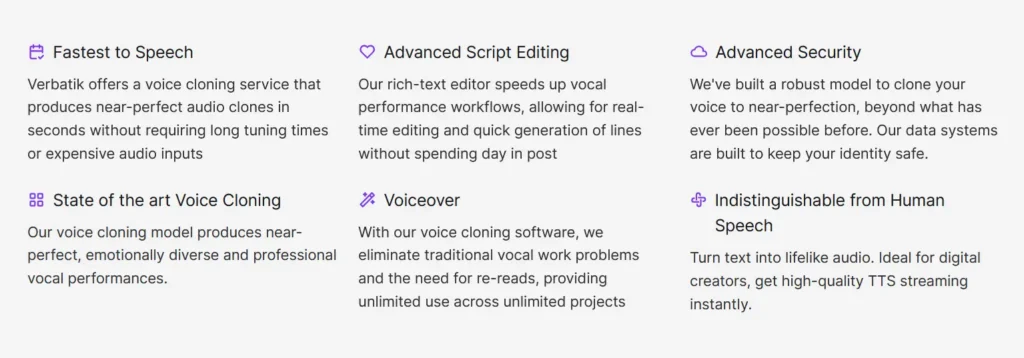
Verbatik AI is a next-generation AI voice generation platform that transforms text into natural-sounding speech. Powered by advanced neural networks, it provides users with high-quality voiceovers suitable for podcasts, explainer videos, e-learning modules, audiobooks, and business presentations. Verbatik supports multiple languages and regional accents, making it an ideal tool for creators targeting global audiences.
Extensive Voice Library
The platform offers access to over 600 AI voices across 140+ languages and dialects. Each voice is optimized for clarity, tone, and emotion, ensuring that users can find the perfect match for their content. Whether for a professional narrator, a friendly conversational tone, or a corporate announcement, Verbatik AI delivers a wide range of realistic options.
Custom Voice Cloning
One of Verbatik AI’s standout features is its custom voice cloning technology. Users can create unique, branded voices by training the AI on short audio samples. This feature allows businesses, influencers, and educators to maintain a consistent voice identity across multiple platforms without needing live recordings.
Speech Editing and Control
Verbatik AI gives users complete control over speech output. You can fine-tune pronunciation, pacing, pitch, and emphasis directly in the editor. The platform also supports SSML (Speech Synthesis Markup Language) for advanced customization, allowing creators to insert pauses, stress words, and add expressions for more dynamic audio experiences.
Integrations and API Access
Verbatik AI integrates easily with popular tools and platforms. Through its API, developers can embed voice generation directly into applications, websites, or learning management systems. This makes it a powerful solution for customer support bots, accessibility features, or automated content production pipelines.
Data Privacy and Security
Verbatik prioritizes user data protection with strict privacy policies and encryption measures. Audio data and custom voice models are securely stored and managed, ensuring confidentiality for enterprise clients and content creators alike.
Pricing and Accessibility
Verbatik AI offers flexible subscription plans catering to individuals, small businesses, and large organizations. Plans vary based on voice access, export formats, and usage limits. A free trial is available, allowing users to test premium voices before committing to a paid plan.
Verbatik AI continues to position itself as a leader in AI voice recognition and text-to-speech technology, providing creators and businesses with powerful, human-like voice tools that enhance digital storytelling and communication.
Performance and Audio Quality
Voice Realism: Natural vs. Robotic
Neural-Quality Voices
Verbatik offers over 600 neural voices in more than 140 languages/dialects, according to its API documentation. This wide variety contributes to more natural and diverse-sounding speech.
Natural Prosody and Intonation
According to Verbatik’s API FAQ, the TTS system uses “advanced neural text-to-speech technology” designed to deliver “appropriate intonation, rhythm, and emphasis,” which helps generate speech that feels human-like rather than robotic.
Customizability via SSML
Users can fine-tune voice characteristics — such as rate (speed), pitch, volume, pauses (breaks), emphasis, and pronunciation — using SSML (Speech Synthesis Markup Language). This level of control lets creators design more expressive, nuanced speech, improving naturalness.
Voice Cloning Quality
Verbatik supports voice cloning: users can record or upload a sample (supported formats: MP3, WAV, M4A, OGG, FLV) to create a custom voice model. When done properly (clear recording, good mic, quiet environment), this cloning produces voice models that closely retain the speaker’s characteristics.
Reported Limitations / Inconsistencies
According to a Reddit user, the German TTS voice in Verbatik mispronounced certain words (“sei” pronounced like “sai”) even when using SSML or phoneme corrections.
That same user also reported a mismatch between Verbatik’s “unlimited cloning” marketing and the actual limit: they could only create up to 3 cloned voices, not unlimited clones.
These observations suggest that while the base voice quality is strong, some language-specific voices or clones may still have pronunciation issues or restrictions.
Speed of Rendering
- Real-Time / Low Latency Performance
According to Verbatik’s own FAQ, speech synthesis is “real-time in most cases,” and converting input text into audio typically “only takes a couple of minutes.” This suggests that for moderate-length scripts, the platform is fast enough for practical use. - Optimized API Throughput
The Verbatik API is designed to scale. On their API page, they mention “lightning-fast processing” and that one can “convert millions of characters in seconds” using their TTS API. This means for high-volume or automated workflows (e.g., generating lots of voiceovers programmatically), Verbatik is relatively efficient. - Audio Quality vs. Size Trade-Off
The generated audio is high-quality, but optimized for clarity and file size according to the API FAQ — specifically using MP3 format. This balance suggests that Verbatik prioritizes efficient rendering without massively large files.
Stability of the Platform
Built for Production Use
Verbatik’s API is designed for production environments: their FAQ explicitly states that the system supports high availability and reliability. That indicates a stable backend infrastructure.
Error Handling & Rate Limits
The API responds with standard HTTP error codes (e.g., 429 for rate limiting) and provides guidance in their documentation. This helps developers gracefully handle request spikes or large workloads.
Voice Cloning Reliability
The voice cloning workflow is well-documented. Verbatik recommends 30–60 seconds of high-quality audio to train a clone, which helps ensure consistent and stable model behavior.
User-Reported Issues
Some users in reviews on Capterra mention limitations in controlling how audio is chunked (“I have not found how to pause readings mid-sentence and have to chop up audio into chunks”).
In Reddit feedback, as noted above, there are concerns about “unlimited” voice cloning actually being capped, plus issues with mispronunciations in specific languages.
There are also complaints (from older user reports) about subscription/licensing practices, such as lifetime deals being revoked. These don’t necessarily reflect system stability, but they speak to user trust and long-term reliability.
Edge Cases Where the AI May Struggle
Pronunciation in Certain Languages / Dialects
As reported by users, Verbatik’s TTS may mispronounce words in less straightforward languages (e.g., German). Even SSML and phoneme tweaking sometimes fail to correct these errors, which may limit usability for language-specific or highly nuanced content.
Cloning Limitations
Despite claims of “unlimited voice cloning,” some users say they were restricted to a very limited number of cloned voices (e.g., 3). This limitation can be a significant barrier for users who need many distinct cloned voices.
Large or Very Long Text Inputs
According to their API FAQ, very long texts may require chunking into smaller parts, as there is a recommended maximum for a single request. This can complicate workflows for audiobook-style generation or very long narrations.
Expressive or Highly Emotional Speech
While Verbatik supports SSML customization, achieving highly dramatic or emotionally rich speech may be challenging because such expressiveness often requires very careful tuning. There’s less public documentation or user evidence that Verbatik’s voices inherently support extreme emotional variance (e.g., crying, shouting).
Audio Format Constraints
The API supports MP3 output at 24 kHz sample rate. While this is adequate for most applications (podcasts, videos), it may not meet the needs of high-fidelity audio production (e.g., studio-grade voiceovers) where higher sample rates or different formats might be preferred.
Misleading Marketing vs Actual Limits
As noted in user reports, some of Verbatik’s marketing (e.g., “unlimited” voice cloning) may be misinterpreted, leading to user frustration when limitations appear. Also, lifetime subscription revocations are reported by some, which could undermine trust.
Overall Assessment
Verbatik AI stands out with a large, high-quality voice library, powerful neural TTS, and extensive customizability via SSML. Its rendering speed is quite competitive, particularly when leveraged via the API, and the system is engineered for reliability and scalable production use.
However, it is not without its limitations: some language-specific voices may mispronounce, cloning is not truly unlimited in practice (according to user reports), and very long texts require chunking. For standard voiceover tasks, e-learning narration, or content in well-supported languages, Verbatik is a strong, professional choice. But if your use case demands very high fidelity, deep emotional expression, or unlimited voice clones across a large number of voices, you might hit some of its current constraints.
Verbatik AI Pricing Plans
Verbatik AI offers a range of pricing tiers to accommodate creators, content professionals, and enterprises looking for high-quality text-to-speech and voice-cloning solutions.
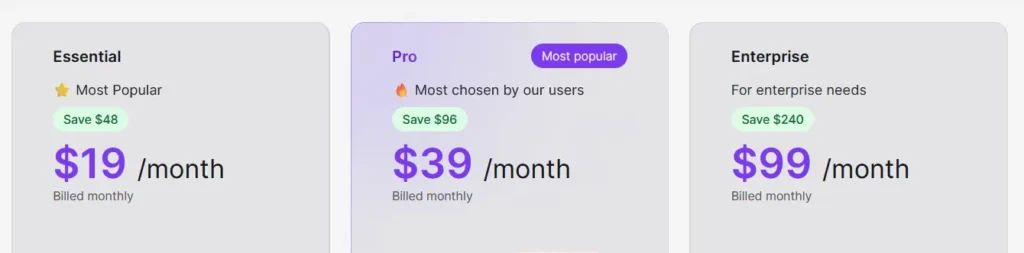
Starter Plan – $9 per month
Ideal for individual creators, this plan includes access to all neural voices, commercial rights, and a set monthly character allowance.Pro Plan – $39 per month
Built for teams and frequent users, this tier increases character limits and unlocks advanced features like voice cloning, API access, and background music generation.Unlimited Plan – $99 per month
Designed for high-volume creators and enterprises, this top tier offers unlimited characters, unlimited voice cloning, full enterprise features, and priority processing.Pay-As-You-Go API – from ~$0.000025 per character
This flexible usage option allows users to pay only for characters processed via API, making it a cost-effective solution for scalable or fluctuating needs.Enterprise Plan – Custom pricing
Tailored for large organizations requiring dedicated support, bespoke licensing, and large-scale deployments. Pricing and terms are negotiated individually.
These structured plans make Verbatik AI accessible for beginners, scalable for professionals, and customizable for enterprise users needing robust voice-generation capabilities.
Customer Support and Service Quality — Verbatik AI
Support Channels & Accessibility
Verbatik offers a support request portal via its website for both general inquiries and enterprise onboarding, ensuring structured support.
According to the Verbatik FAQ, users can reach support via email.
For billing-specific support, the documentation points to a dedicated email.
Verbatik’s documentation includes detailed guides for subscription management, billing, credit usage, and more.
Support Level by Plan
In its subscription pricing, Verbatik explicitly distinguishes support levels by plan:
- Creator plan: Standard support
- Pro plan: Priority support
- Ultimate (Enterprise) plan: Premium suppor
This tiered support structure indicates that high-volume or business users get faster or more dedicated support, consistent with enterprise needs.
Self-Service Resources
Verbatik maintains a comprehensive FAQ section covering technical details, credit usage, billing, and voice cloning, helping users resolve common queries independently.
Their knowledge base is up-to-date and clearly laid out, which reduces the need for support tickets for routine issues.
Service Reliability & Business Use
In enterprise contexts, Verbatik provides a custom onboarding process and dedicated success manager, reinforcing a strong commitment to service quality for business clients.
According to a Verbatik case study, one customer integrated Verbatik’s TTS API into its customer service pipeline and reported substantial efficiency improvements.
This suggests good reliability for mission-critical applications, as well as high documentation quality for API integration.
Strengths and Risks in Support Quality
Strengths:
Tiered support ensures higher-paying users or enterprise customers receive faster, more dedicated assistance.
Robust self-service documentation and FAQ reduce reliance on direct support, improving efficiency.
Business reliability: Enterprise users benefit from onboarding, dedicated success management, and API stability, which is critical for large-scale deployments.
Risks / Challenges:
Mixed user reviews: The lower Trustpilot rating and complaints about subscription cancellation suggest some friction in customer service experiences.
Support latency for lower tiers: Standard support for entry-level plans may not be as responsive as higher-tier plans, potentially affecting less frequent users.
Email-based support for non-enterprise: Without a clearly documented live chat or phone line for all users, response times may vary.
Verbatik AI provides a well-structured and professional support system, especially for paying and enterprise users. Its tiered support model, detailed self-help documentation, and dedicated resources for business clients suggest a mature and scalable customer service organization. However, user feedback shows some inconsistency, especially around cancellation processes and support responsiveness at lower subscription levels. For commercial or high-volume use, Verbatik’s premium support and onboarding are a strong plus—but individual users on basic plans should be aware of potential limitations.
Verbatik AI: Pros and Cons
Pros of Verbatik AI
- Wide Voice Selection: Verbatik AI provides over 800 realistic voices across 130+ languages and accents, making it suitable for global projects and multilingual content.
- High-Quality Output: The tool generates natural-sounding speech using advanced AI, ideal for podcasts, audiobooks, and video narration.
- Flexible Usage and Licensing: Paid plans include full commercial rights, allowing users to monetize their voiceover content without restrictions.
- Custom Voice Options: Users can create personalized voice clones for consistent brand or character voices.
- Simple and Fast Interface: The platform’s intuitive editor enables quick conversion of text to audio with minimal learning curve.
Cons of Verbatik AI
- Limited Free Access: The free plan offers restricted usage and features, requiring upgrades for extended access or commercial projects.
- Internet Dependence: Voice generation and downloads require an active online connection.
- Occasional Pronunciation Errors: Certain complex words or brand names may need manual adjustment for accurate speech.
- No Offline Editing: Users cannot work or export files without internet connectivity.
Verbatik AI delivers high-quality, multilingual voice generation with impressive customization and commercial flexibility. However, its free tier is limited, and users seeking advanced control or offline functionality may need to consider higher-tier plans.
Verbatik AI Competitors and Alternatives
Verbatik AI is a text-to-speech (TTS) platform that offers high-quality AI-generated voices, multilingual support, and customizable speech controls for creators, businesses, and developers. Known for its natural-sounding voices and easy audio generation workflow, Verbatik AI is widely used for podcasts, video voiceovers, e-learning content, and product narration. However, depending on whether users need deeper voice cloning, advanced APIs, wider language support, or more realistic neural speech models, several strong alternatives provide compelling capabilities. Understanding how these platforms differ can help users choose the best tool for their voice generation needs.
ElevenLabs
ElevenLabs is one of the industry leaders in AI voice synthesis, known for its highly realistic neural voices and advanced voice cloning.
Strengths:
Best-in-class natural and expressive voice quality;
Advanced voice cloning with high accuracy;
Wide language support and strong developer APIs;
Considerations:
Some features require higher-tier plans;
May be more complex for casual users who only need simple TTS;
WellSaid Labs
WellSaid Labs specializes in professional-grade synthetic voices tailored for business applications such as training, marketing, and product videos.
Strengths:
Studio-quality voice avatars;
Strong focus on consistency and professional narration;
Ideal for enterprise teams and e-learning content;
Considerations:
Higher pricing compared to general-purpose TTS tools;
Less flexibility for experimental or highly custom voice generation;
Murf AI
Murf AI is a versatile voice generator offering realistic voices alongside a built-in editor for creating videos and presentations.
Strengths:
Large library of natural-sounding voices;
Integrated editing tools for timing, emphasis, and pitch;
Great for marketing, training, and product explainer videos;
Considerations:
Less advanced voice cloning compared to ElevenLabs;
More focused on content creators than developers;
Conclusion for Verbatik AI review
In conclusion, Verbatik AI delivers a powerful blend of usability, scalability, and voice-generation quality that makes it a standout choice for creators, educators, and businesses seeking reliable text-to-speech solutions. Its extensive voice library, flexible pricing, and advanced features like voice cloning and SSML control provide users with a level of customization that rivals top competitors. From global content creation to automated workflows and branded voice experiences, the platform offers an impressive toolset that supports both casual experimentation and professional-grade production.
However, as highlighted throughout this Verbatik AI Review, the platform is not without limitations. Occasional pronunciation errors, plan-specific restrictions, and feedback regarding customer support responsiveness may be considerations for some users, particularly those working in niche languages or managing enterprise-level demands. Even so, Verbatik AI remains a strong and evolving contender in the AI voice technology landscape, and for many users, its blend of versatility, performance, and accessibility will outweigh any drawbacks—making it a compelling option for modern digital voice creation.
Verbatik AI Coupon – Save More on AI Text-to-Speech Voices
Verbatik AI provides built-in savings when you choose an annual plan, and by purchasing through this link, you can unlock additional discounts on yearly subscriptions compared to standard monthly pricing. These savings make it easier to access Verbatik’s high-quality AI voice and text-to-speech tools at a lower cost.
To claim this offer, simply click this link to visit Verbatik AI’s official website. When you select an annual plan, any eligible discounts—including the extra savings available through this link—will be automatically applied at checkout.
Verbatik AI – Frequently Asked Questions
1. What is Verbatik AI?
Verbatik AI is an AI-powered text-to-speech (TTS) platform that converts written text into natural-sounding audio. It offers a large library of AI voices and supports a wide range of use cases including podcasts, videos, audiobooks, training materials, and commercial content.
2. How does Verbatik AI work?
Users enter or paste text into the platform, choose from available voices, and customize settings like speed, pitch, or emphasis. The system uses neural text-to-speech models to generate high-quality audio, which can then be downloaded in preferred formats.
3. What types of voices does Verbatik AI offer?
Verbatik AI provides hundreds of AI voices across different languages, accents, genders, and vocal styles. The library includes conversational voices, professional narrators, character voices, storytelling voices, and regional accents.
4. Does Verbatik AI support multiple languages?
Yes. Verbatik AI supports a large number of languages, typically including English, Spanish, French, German, Arabic, Hindi, Chinese, Portuguese, and many others. The platform continues to expand its language offerings over time.
5. Can I use Verbatik AI for commercial projects?
Yes. Verbatik AI allows commercial usage on its paid plans. This includes using generated audio in videos, advertisements, e-learning courses, apps, and other published content.
6. Is there a free version of Verbatik AI?
Verbatik offers a Free Plan with limited voice generation and preview options. However, exporting full-length or high-quality audio generally requires upgrading to a paid plan.
7. Does Verbatik AI offer voice cloning?
Verbatik AI includes voice cloning capabilities on certain plans, allowing users to create custom AI voices from recorded samples. This feature typically requires user-provided voice data and compliance with identity verification rules.
8. How natural-sounding are the voices?
The platform uses advanced neural speech synthesis, which produces highly natural and expressive voices. While quality varies between voices, many sound close to human narration, especially premium neural voices.
9. What audio formats can I export in?
Verbatik AI typically supports exports in MP3 and WAV formats. Higher-tier plans may allow higher bitrate or lossless audio exports.
10. Can I control speed, tone, and pronunciation?
Yes. Verbatik AI includes detailed audio controls such as speed, pitch, pauses, emphasis, and custom pronunciation dictionaries—useful for names, technical terms, or brand-specific phrasing.
11. Does Verbatik AI integrate with other tools?
Verbatik provides an API that allows developers to integrate text-to-speech capabilities into apps, websites, and automated workflows. The platform is also compatible with standard audio and video editing tools.
12. Is Verbatik AI suitable for YouTube videos or podcasts?
Yes. Many creators use Verbatik AI for narration, intros, and full-length voiceovers. Its licensing on paid plans allows commercial distribution on platforms like YouTube, Spotify, and TikTok.
13. How secure is my data on Verbatik AI?
Verbatik uses standard encryption and security practices to protect user data. Voice cloning features require explicit permission and may involve identity checks to prevent unauthorized voice replication.
14. What industries commonly use Verbatik AI?
Verbatik AI is widely used in e-learning, marketing, audiobook production, customer service automation, software development, and content creation for social media and advertising.
15. Who is Verbatik AI best suited for?
The tool is ideal for creators, educators, agencies, developers, and businesses that need fast, customizable, and high-quality audio without hiring voice actors or recording equipment.