Deep Art AI Review (2026): A Cutting-Edge Animation AI Tool for Digital Creators
In this Deep Art AI review, we explore how this innovative platform is transforming the world of digital art, animation, and visual storytelling. Deep Art AI is one of the most advanced animation AI tools available today, using powerful neural networks to turn static images, sketches, or video frames into dynamic, stylized animations. Designed for artists, designers, and content creators, it bridges the gap between creativity and technology—making professional-level animation accessible to everyone.
Deep Art AI’s core strength lies in its ability to analyze artistic styles and apply them intelligently to images and motion sequences. Users can upload a photo or video, select a preferred art style—from oil painting to 3D render effects—and watch as the AI transforms the content into a vivid, animated masterpiece. The process is fully automated, yet highly customizable, allowing users to adjust details such as motion intensity, frame rate, and visual effects for more refined results.
For animators and studios, Deep Art AI integrates seamlessly with popular software such as Blender, After Effects, and Maya, enhancing traditional animation workflows. Its AI-powered rendering engine drastically reduces production time while maintaining artistic quality—making it ideal for social media videos, advertising, short films, and even game design.
Pros:
- AI-powered animation from still images or video sequences
- Wide range of artistic styles and visual effects
- Integration with major animation and editing software
- Cloud-based system for fast, hardware-free rendering
- User-friendly interface suitable for beginners and professionals
- Ideal for marketing, film, and digital content creation
Cons:
- Free plan includes limited rendering time and resolution
- Advanced style customization requires a paid plan
- Processing complex animations can take time on large files
In conclusion, Deep Art AI stands out as a next-generation animation AI tool for creators who want to merge artistic expression with artificial intelligence. Its combination of style transfer, animation automation, and professional integration makes it an invaluable asset for anyone working in animation, digital art, or visual storytelling. In 2025, Deep Art AI continues to redefine how creativity and AI come together to produce stunning, animated works of art.
3.8
Average from 16 verified reviews
Pricing
3 Month Subscription – $9.99 per month
1 Year Subscription – $7.99 per month
Lifetime license – $149.99 per month
About Deep Art AI
Deep Art AI is an innovative artificial intelligence platform developed by DeepArtEffects, a German-based company specializing in creative AI technologies. The platform harnesses the power of deep neural networks to transform photos, videos, and digital art into stunning, stylized masterpieces inspired by famous artists and painting techniques.
Deep Art AI goes beyond simple filters—its algorithms analyze each image’s structure, color, and texture to recreate it in an entirely new artistic form. Users can apply a wide variety of styles—from classical painters like Van Gogh, Monet, and Picasso to modern digital aesthetics—making it a favorite among artists, designers, and creative professionals seeking unique visual effects.
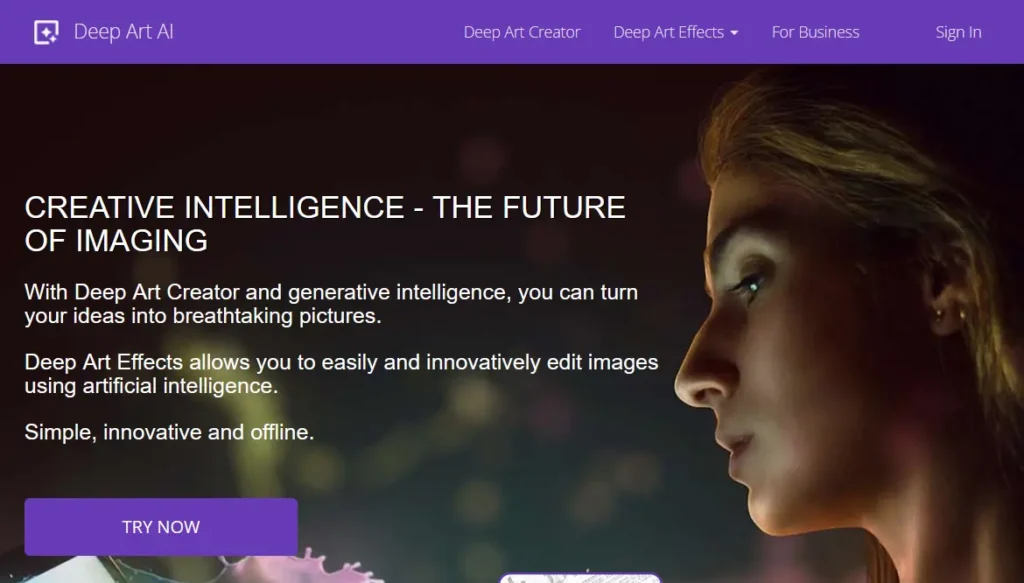
The company’s mission is to combine art and technology, empowering users to express creativity effortlessly through AI. Deep Art AI provides both consumer-friendly apps for mobile and desktop users and enterprise-grade APIs that allow developers and companies to integrate artistic style transfer into their own products or workflows. This makes it ideal for use in digital marketing, content creation, gaming, and design industries.
DeepArtEffects has also focused heavily on performance and privacy. The platform processes images efficiently while ensuring user data security—a priority for professionals working with sensitive creative material. Users can choose between cloud-based processing or on-premise deployment, a flexibility rarely found in similar AI art tools.
With its seamless blend of artistic innovation and AI-driven precision, Deep Art AI continues to redefine the boundaries of digital creativity, making professional-grade artistic transformation accessible to everyone—from casual creators to enterprise-level design teams.
Key Features of Deep Art AI
AI-Powered Artistic Transformation
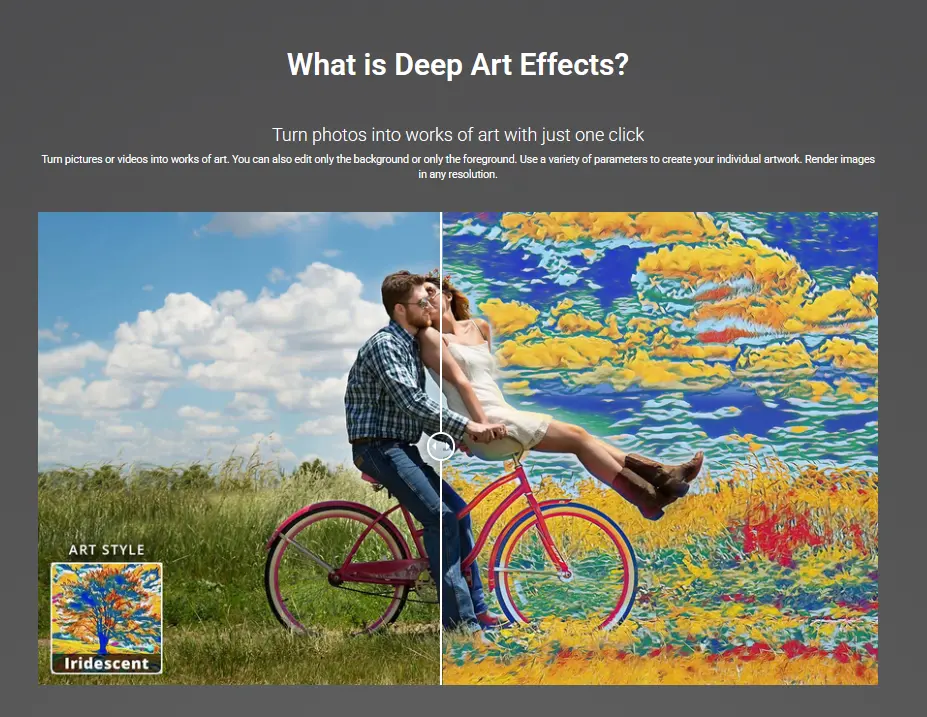
Deep Art AI is a leading artificial intelligence platform that transforms photos into digital artworks using advanced neural networks. Powered by deep learning algorithms inspired by the human brain, Deep Art AI allows users to reimagine their images in the style of famous painters such as Van Gogh, Picasso, and Monet. The platform’s technology analyzes both the content and artistic features of images to produce high-quality, style-transferred artworks with exceptional detail and texture.
Style Transfer Engine
At the core of Deep Art AI is its proprietary style transfer engine, which combines the visual characteristics of one image (the “style”) with the structure of another (the “content”). Users can upload their own photos and select from a vast library of artistic filters, or even upload a custom style image to create personalized art. The result is a one-of-a-kind digital artwork that blends creative expression with cutting-edge AI capabilities.
High-Resolution Rendering
Deep Art AI supports high-resolution rendering suitable for professional use, including digital prints, posters, and large-scale reproductions. The system leverages GPU acceleration to process complex neural network computations efficiently, ensuring artworks retain both visual fidelity and color depth, even at larger formats.
Customizable Artistic Filters
Users can choose from hundreds of curated art styles categorized by genre, artist, and mood—ranging from classical oil painting effects to abstract, surreal, or modern digital styles. Each filter can be adjusted in intensity, giving creators full control over how much of the original image or the chosen style is emphasized in the final artwork.
Web and Mobile Accessibility
Deep Art AI is available through an intuitive web interface and a mobile app, making it accessible to both casual users and professional artists. The drag-and-drop upload system, preview feature, and responsive design ensure a seamless experience across devices, whether users are editing photos from their desktop or smartphone.
API Integration for Developers
Beyond individual use, Deep Art AI provides an API that allows developers and businesses to integrate its style transfer capabilities into their own applications. This is particularly useful for creative platforms, digital marketing agencies, and printing services seeking to offer AI-generated artwork as part of their product offerings.
Privacy and Data Protection
Deep Art AI prioritizes user privacy and data security. Uploaded images are processed securely on cloud servers, and users have the option to delete their data permanently after artwork generation. The platform complies with GDPR standards, ensuring transparency and control over personal content.
Premium Plans and Commercial Licensing
While Deep Art AI offers free previews and basic image transformations, premium subscriptions unlock higher resolution exports, faster processing times, and access to exclusive artistic styles. Commercial licensing options are available for professionals who wish to use AI-generated artworks for resale, branding, or design purposes.
Community and Creative Inspiration
The Deep Art AI community showcases user-generated artworks from around the world, providing inspiration and demonstrating the platform’s versatility. Artists, photographers, and designers frequently share their creations, illustrating how AI can complement human creativity in modern digital art.
Deep Art AI continues to redefine the boundaries between art and technology—empowering users to turn ordinary photos into extraordinary works of art with just a few clicks. By merging neural networks with artistic imagination, it makes professional-grade creative expression accessible to everyone, from hobbyists to seasoned digital artists.
DeepArt — Performance and Art Quality
What DeepArt Does / Overview of Its Approach
- Neural Style Transfer Platform
DeepArt uses a neural-style transfer algorithm (based on deep convolutional neural networks) to transform user-supplied photos into artworks — combining the “content” of the photo with the “style” of another image (often a painting) to produce a stylised result. - Accessible, User-Friendly Workflow
Users simply upload a photo (e.g. portrait, landscape, architecture), pick a style from a gallery or upload their own style image, then let the AI process it. No coding or technical expertise needed. - High-Resolution & Print-Ready Outputs
DeepArt aims at producing high-resolution images, suitable for printing (posters, canvas, art prints) or other professional uses. Creative Flexibility
The platform offers a variety of predefined art styles (classical, modern, abstract, painterly, etc.) inspired by famous artists/art movements — and allows custom style uploads — giving broad creative flexibility.
Performance (Speed, Usability, Output Generation Time)
Relatively Quick Processing
Despite the complexity of style-transfer computation, DeepArt is generally described as capable of producing results “within minutes.” For many typical use-cases, this constitutes a reasonable compromise between quality and speed.
Web-Based, No Installation Required
Because DeepArt runs in the browser (no need for local installation), it lowers barriers to entry: any user with a modern browser can use it, which simplifies access especially for non-technical or casual users.
Sufficient for Rapid Creative Iteration
The ease of use and relatively quick turnaround make DeepArt suitable for creative workflows that benefit from experimentation — e.g. testing different styles, generating multiple variants, iterating quickly.
Art Quality — Style Transfer, Visual Fidelity, Aesthetic Output
Strong Style Transfer Capability
DeepArt’s neural style transfer retains the structural content of the original photo (shapes, composition, depth) while applying stylistic features: brush strokes, textures, color palettes, and tone — often successfully emulating painterly or artistic styles (e.g. reminiscent of classic or modern artworks).
High-Resolution, Print-Ready Output
The high-resolution output allows for “print-quality” artworks — suitable for posters, canvas prints, digital art portfolios, or commercial uses.
Creative and Customizable Results
Because users can pick from many predefined styles or upload their own style reference images, DeepArt enables a wide range of aesthetic possibilities — from classical, impressionistic, abstract, to highly stylized modern artworks. This flexibility supports creative experimentation and lets users tailor the output to their vision.
Some Trade-offs and Limitations
Detail Loss / Blurriness for Fine Detail: For some source images — especially very detailed ones — transformations can lose fine textures or subtle details. For instance, intricate patterns or very small features may become blurred or be smoothed out during style transfer.
Consistency Isn’t Guaranteed: The quality of output can vary depending on the input image and style chosen; certain combinations may yield excellent results, others may produce overly stylized or less coherent images.
Limited Fine-Tuning Controls: Compared to manual digital painting or advanced graphic tools, DeepArt gives less granular control over how style is applied (e.g. brush detail, local vs. global style intensity, selective style masking) — which constrains precision for professional artists seeking exact aesthetic control.
Suitability, Use Cases & Limitations
Best Use Cases
- Artists, designers or hobbyists who want to quickly turn photos into stylized artworks without manual painting or extensive editing.
- Content creators, marketers, social-media managers, or brand designers needing eye-catching visuals for posts, marketing materials, ads, posters.
- People interested in creative experimentation — exploring different art styles, generating multiple variants, or mixing style & content in unconventional ways.
- Print-on-demand, merchandise, interior decor (posters, canvas prints), or personal gifts — leveraging the high-resolution, stylized outputs as artwork.
Limitations / When It Is Less Suitable
- For works that demand tight control over brush strokes, textures, selective edits, or detailed local adjustments — DeepArt may fall short.
- When maintaining subtle visual fidelity (e.g. small facial details in portraits, photographic realism plus style) — stylization may override fine detail.
- For animations, video-style motion, or dynamic content: DeepArt is not designed for video generation or frame-by-frame animation (it produces static images).
- For professional-quality digital painting or illustration where the artist wants full creative control, DeepArt’s automated approach may feel too “hands-off.”
Deep Art AI Pricing Plans
Deep Art AI, also known as Deep Art Effects, offers a range of subscription plans designed for digital artists, content creators, and professionals who want to transform photos into artistic masterpieces using artificial intelligence. The platform provides both short-term and lifetime access options, catering to various creative and professional needs.

- 1-Month Subscription – $11.99 per month
The monthly plan gives users full access to all Deep Art AI features, including unlimited art styles, HD image rendering, and offline use via the desktop application. It’s a flexible choice for users who want to experiment with AI-powered image transformation on a short-term basis without a long commitment. - 3-Month Subscription – $ 9.99/month)
The 3-month plan offers the same comprehensive set of tools as the monthly plan but at a discounted rate. It’s ideal for users who plan to use Deep Art AI regularly for a few months, such as for specific creative projects or seasonal campaigns. - 12-Month Subscription – $7.99/month
The annual subscription provides the best value for long-term users. It includes unlimited access to all art filters, continuous software updates, and priority support. This plan is perfect for professionals or agencies who rely on AI-powered design tools throughout the year. - Lifetime License – $149.99 one-time payment
For users seeking permanent access, the lifetime license offers full use of Deep Art AI without recurring fees. It includes all current and future updates within the purchased version, free support, and unrestricted use of all filters and styles. This plan is best suited for frequent creators who want a one-time investment for ongoing creative freedom.
All plans include free software updates, access to all AI filters, and technical support, ensuring users can consistently produce high-quality, stylized artwork across desktop and mobile platforms.
Customer Support & Service Quality — Deep Art Effects
Support Channels & Contact Options
Deep Art Effects provides email support.
For business or developer inquiries, they maintain a contact form on their developer portal.
Self-Service Resources
According to external reviews, Deep Art Effects provides an AI-powered chatbot on its website that handles common support issues and routes more complex questions to human staff.
Their documentation (via the developer portal) covers style-transfer API usage, which is helpful for technical users.
Service Reliability & Transparency
- Deep Art Effects is operated by Deep Art Effects GmbH, a German company (Kriegsstraße 82, Karlsruhe).
- Their Imprint / Developer Contact page helps establish transparency in business operations.
- According to user-reported experiences, some support issues relate to licensing and billing; Deep Art Effects appears willing to engage and resolve such issues.
- Their mobile app (iOS) lists the same support email and phone number, reinforcing consistency in support across platforms.
Strengths and Potential Challenges
Strengths:
Multiple support channels: Email and telephone support give users a choice.
Good self-service tools: AI chatbot and developer documentation help users help themselves.
Responsive to complaints: On Trustpilot and other platforms, Deep Art Effects has responded to negative feedback, indicating active customer engagement.
Transparent company identity: The business address and company name are publicly disclosed, which increases accountability.
Challenges / Risks:
Mixed customer satisfaction: While many praise the support, some users report issues with billing or account management.
Support hours ambiguity: Though Deep Art claims “near-24/7” support, some users still report slower response times.
No formal SLA visible: There is no clearly stated Service-Level Agreement guaranteeing response times or resolution times for issues.
Complex technical issues: For advanced users (e.g., API customers), more in-depth documentation or specialized support may be needed.
Deep Art Effects delivers solid and multi-faceted customer support, combining email, phone, and an AI chatbot to address user needs. Their commitment to transparency and responsiveness is evident in user reviews, though support quality is not uniformly perfect — especially on more complex issues like billing or high-volume usage. For casual users, the support infrastructure is more than adequate; for enterprise or developer users, they may want to clarify expectations around response times and technical assistance.
Deep Art AI: Pros and Cons
Pros of Deep Art AI
- High-quality artistic transformations: Deep Art AI uses neural style transfer to convert photos into artworks modeled after famous artistic styles, delivering visually impressive and detailed outputs.
- Wide selection of artistic styles: Users can choose from dozens of predefined styles—ranging from classical painting to modern digital aesthetics—or upload custom styles for more personalized results.
- Beginner-friendly interface: The platform is simple to use, requiring only an image upload and style selection, making it accessible to non-designers and casual users.
- Fast rendering for standard images: Most artworks are generated quickly, allowing users to iterate and experiment with multiple styles without long wait times.
- Suitable for creative professionals: Designers, photographers, and artists use Deep Art AI for concept art, social media content, posters, and unique visual assets.
Cons of Deep Art AI
- Limited control over fine-tuning: Although the AI applies styles effectively, users have limited control over parameters such as brush intensity, texture weight, or detail level compared to more advanced art tools.
- Higher-resolution images may require paid tiers: To download rendered images in full resolution for commercial or print use, a paid plan is typically required.
- Not ideal for original illustration: Deep Art AI excels at style transfer rather than generating new images from text or complex prompts, which may limit its flexibility compared to newer generative AI art models.
- Processing may slow with complex styles: Some highly detailed artistic styles take longer to render and may require multiple attempts for optimal quality.
Deep Art AI is a powerful and easy-to-use tool for transforming images into stylized artwork, making it a great choice for creative enthusiasts and professionals seeking unique visual effects. While its strengths lie in simplicity and artistic quality, users needing deeper customization or advanced generative features may find the platform somewhat limited.
Deep Art AI Competitors and Alternatives
In the rapidly evolving world of 3D and Animation AI Tools, Deep Art AI is known for transforming images and videos into stylized artwork using neural style transfer and advanced generative models. Its capabilities are popular among designers, artists, and content creators seeking to convert standard visuals into unique artistic outputs. However, it isn’t the only tool offering AI-powered artistic rendering and animation enhancement. Depending on your needs—whether it’s video stylization, real-time animation, 3D generation, or high-fidelity artistic filters—several strong alternatives exist. From powerful AI-art engines like Prisma and DeepDream to animation-focused solutions such as Runway and Kaiber, each platform brings its own strengths that can support different creative workflows.
Runway
Runway provides a suite of AI-powered creative tools designed for video editing, animation, and generative visual effects, making it a leading alternative for artistic video creation.
Strengths:
Advanced AI models for video generation, editing, and style transfer;
Real-time capabilities ideal for creative studios;
Wide model library suitable for both artistic and cinematic outputs;
Considerations:
Can be resource-intensive for complex projects;
Higher-tier features may require professional-level plans;
Kaiber
Kaiber specializes in AI-driven video generation and stylization, enabling creators to transform footage into various artistic styles and animated sequences.
Strengths:
Strong focus on turning images or videos into stylized animations;
Wide range of artistic styles and cinematic presets;
Easy-to-use interface for artists and content creators;
Considerations:
Limited control for detailed, frame-specific editing;
Primarily suited for stylized video, not full 3D workflows;
Prisma
Prisma is one of the most well-known AI image stylization apps, using advanced neural style transfer to convert photos into artwork inspired by famous art styles.
Strengths:
High-quality artistic filters with excellent detail;
Broad variety of styles inspired by classical and modern art;
Fast and accessible for everyday creators;
Considerations:
Mainly focused on images, not video or 3D animation;
Limited advanced customization options;
DeepDream

DeepDream is a pioneering AI art tool that generates surreal, abstract, and dream-like transformations using early neural visualization techniques.
Strengths:
Unique and recognizable artistic outputs;
Highly flexible for experimental and abstract art;
Popular among creators exploring unconventional styles;
Considerations:
Outputs can be unpredictable and less suitable for commercial use;
No native tools for animation or video workflows;
Conclusion for Deep Art AI review
As explored throughout this Deep Art AI Review, the platform stands out as a sophisticated yet accessible solution for creators seeking high-quality artistic transformations. Its powerful neural style transfer engine, wide selection of artistic filters, and ability to generate high-resolution, print-ready images make it a valuable tool for artists, designers, marketers, and hobbyists alike. Deep Art AI succeeds in blending technical innovation with creative freedom, enabling users to turn ordinary photos into striking works of art with impressive ease. From API integrations to mobile accessibility, it supports a diverse range of creative workflows without requiring advanced technical skills.
While the platform does have limitations—such as reduced fine-tuning control and slower processing for highly complex styles—its strengths far outweigh these drawbacks. Deep Art AI remains a reliable and versatile choice for those who want to experiment with unique visual aesthetics, enhance their design projects, or produce professional-grade art quickly. With its growing feature set, robust rendering capabilities, and commitment to both performance and user privacy, Deep Art AI continues to push the boundaries of what AI-powered creativity can achieve in 2025 and beyond.
Frequently Asked Questions
1. What is Deep Art AI mainly used for?
Deep Art AI is primarily used for neural style transfer, allowing users to transform photos into artistic images inspired by famous painters or custom art styles. It is commonly used for digital art, social media visuals, posters, marketing creatives, and print-ready artwork rather than original image generation.
2. Does Deep Art AI generate images from text prompts?
No. Deep Art AI does not generate images from text prompts. Unlike generative AI tools such as Midjourney or DALL·E, Deep Art AI requires an existing image and applies an artistic style to it using neural style transfer technology.
3. Can Deep Art AI be used for commercial projects?
Yes. Paid plans include commercial usage rights, allowing users to sell, print, or use generated artworks for branding, marketing, merchandise, or client projects. Users should still ensure they own the rights to the original images they upload.
4. Is Deep Art AI suitable for professional printing?
Yes. Deep Art AI supports high-resolution, print-ready outputs, making it suitable for posters, canvas prints, wall art, and other large-format designs when using paid plans.
5. Does Deep Art AI work with videos or animations?
Deep Art AI is not designed for video or animation generation. It focuses exclusively on static image transformation. Users looking for AI-based video stylization or animation should consider tools like Runway or Kaiber instead.
6. Can users upload their own art styles?
Yes. In addition to predefined styles, Deep Art AI allows users to upload custom style reference images, enabling more personalized artistic transformations beyond the default style library.
7. Is Deep Art AI beginner-friendly?
Yes. The platform is designed to be easy to use, requiring no design or technical skills. Users simply upload an image, choose a style, and let the AI process the artwork through a straightforward interface.
8. How long does it take to process an image?
Most standard images are processed within a few minutes. Processing time can increase for high-resolution files or complex styles, especially during peak usage periods.
9. Does Deep Art AI offer an API for developers?
Yes. Deep Art AI provides an API for developers and businesses, allowing style transfer features to be integrated into third-party apps, websites, or creative platforms. This is commonly used by printing services and creative software companies.
10. Is Deep Art AI safe in terms of data privacy?
Yes. Deep Art AI complies with GDPR standards and allows users to delete uploaded images after processing. The company also offers on-premise deployment options for enterprise users who require additional data control.
11. What are the main limitations of Deep Art AI?
The main limitations include:
- No text-to-image generation
- Limited fine-grained artistic control compared to manual design tools
- Static images only (no video or motion output)
- High-resolution exports require a paid plan
These limitations reflect its focus on style transfer rather than full generative art creation.
12. Who should consider alternatives to Deep Art AI?
Users who need AI video generation, frame-by-frame animation, or advanced generative visuals may find Deep Art AI too limited. In such cases, tools like Runway, Kaiber, or newer generative AI platforms may be more suitable.