Undatas IO Review (2026): An Advanced Platform for AI for Data & Analytics
In this Undatas IO review, we examine why Undatas IO is becoming a noteworthy option in the realm of AI for Data & Analytics—particularly for businesses dealing with large volumes of unstructured data. Undatas IO offers a platform designed to convert PDFs, images, video/audio, and other non‑structured formats into structured, AI‑ready data.
Undatas IO is built around the idea of turning chaotic document inputs into clean, machine‑readable formats such as JSON, CSV, Markdown or Parquet.
Pros
- Converts unstructured data into structured formats (JSON, CSV, Parquet)
- Supports a wide range of file types including PDFs, images, and videos
- Cloud-based and API-accessible for easy integration into AI workflows
- Speeds up data preparation for analytics and AI applications
- Flexible pricing with free trial options
Cons
- Complex or low-quality inputs may still require manual review
- Focuses on data extraction, not full analytics or visualization
- Limited enterprise case studies for large-scale adoption
Undatas IO remains a solid choice for teams and organizations looking to simplify data ingestion and preparation. Its AI-driven approach makes it one of the most practical tools in the AI for Data & Analytics space in 2025.
4.2
Average from 768 verified reviews
Pricing
Lifetime Deal – $198 per month
Pay-As-You-Go – from $30 one-time purchase
UnDatas IO is a leading platform in the space of AI for Data & Analytics, designed to transform unstructured documents and multimedia content into structured, machine-readable formats. By supporting a wide range of file types—such as PDFs, Word documents, images, audio, and video—UnDatas IO streamlines the often-tedious task of preparing data for analytics, large language model workflows, and automation.
The platform stands out thanks to its sophisticated document-layout recognition, table extraction, formula parsing, and transcription capabilities. With its V3 release, UnDatas IO introduced a “glass-box” interface that enables visual validation of extracted elements, along with a “pay for quality” model that ensures users only consume credits when output meets their standards.

UnDatas IO offers functionality tailored for developers, analysts, and enterprises, including API access, credit-based usage, and integrations with cloud storage. Its mission centers on making unstructured data accessible and actionable—enabling users to convert messy documents into clean JSON or Markdown and then build insights, automation, or AI applications on top of them.
With its combination of high parsing accuracy, flexible deployment options, and focus on data integrity and transparency, UnDatas IO represents a powerful solution for teams looking to get the most from their data—regardless of where it begins.
Key Features of Undatas IO
Data Integration and Automation
Undatas IO is an advanced data automation and analytics platform that simplifies the process of integrating, transforming, and managing large datasets. It allows businesses to connect various data sources—including databases, CRMs, APIs, and cloud storage—into a unified system. The platform’s no-code and low-code tools enable users to automate repetitive data workflows, ensuring that analytics teams can focus on insights rather than manual processing.
ETL (Extract, Transform, Load) Capabilities
A core feature of Undatas IO is its powerful ETL engine. Users can extract data from multiple sources, transform it through cleaning, enrichment, and normalization, and then load it into destinations such as data warehouses or visualization tools. The platform supports scheduled and real-time ETL operations, allowing organizations to maintain up-to-date analytics pipelines effortlessly.
AI-Powered Data Analysis
Undatas IO integrates artificial intelligence to enhance decision-making through pattern recognition, trend forecasting, and anomaly detection. Its AI models analyze historical and live data to generate actionable insights automatically. Users can also build and deploy their own custom machine learning models within the platform, expanding the potential for predictive analytics across diverse business functions.
Data Visualization and Reporting
The platform includes a suite of interactive dashboards and visualization tools that help teams turn complex data into clear, actionable visuals. Users can create charts, reports, and key performance dashboards customized to their business goals. These visualizations update in real time as new data flows in, ensuring accuracy and immediate insight delivery.

Collaboration and Workflow Management
Undatas IO supports seamless collaboration among teams. Multiple users can work on shared data pipelines, dashboards, and reports simultaneously, with role-based access controls to ensure data security. Built-in commenting and version tracking features enhance communication, allowing data teams to collaborate effectively across departments.
Data Governance and Compliance
Data security and governance are top priorities for Undatas IO. The platform includes granular permission settings, encryption, and automated data auditing to ensure compliance with GDPR, HIPAA, and other international data protection standards. This makes it suitable for organizations in regulated industries such as finance, healthcare, and e-commerce.
Integration Ecosystem
Undatas IO connects with a wide range of business and analytics tools, including Snowflake, Google BigQuery, Redshift, Power BI, and Tableau. It also supports API integration for custom applications, enabling a flexible and extensible data architecture that fits unique business needs.
Scalability and Performance
Built on a cloud-native infrastructure, Undatas IO scales efficiently as data volumes and user demands grow. It supports high-performance processing for large datasets and concurrent workflows without compromising speed or reliability. This makes it ideal for enterprises managing complex, data-intensive operations.
Automation and Alerts
Users can set up automated workflows and notifications for key metrics, anomalies, or system changes. These smart alerts ensure stakeholders are immediately informed about critical data trends or operational shifts, helping businesses act swiftly and decisively.
Flexible Pricing and Accessibility
Undatas IO offers flexible pricing based on data usage and feature requirements, catering to both startups and large enterprises. A free trial or demo option is typically available, allowing organizations to explore the platform’s capabilities before full deployment.
Undatas IO continues to redefine modern data integration and analytics by combining automation, AI-driven insights, and scalable infrastructure—empowering businesses to transform raw data into actionable intelligence with precision and speed.
Undatas IO Performance and Accuracy
Speed of Processing / Responsiveness
- Fast per-page processing
According to the publicly-available specs, UndatasIO processes pages in around ~ 3 seconds per page for parsing. - API and bulk / high-throughput support
With the launch of the “V3 API,” UndatasIO supports automating document processing at scale: you can programmatically upload documents, parse them, review structured output, and integrate results into larger workflows or pipelines. - Flexible parsing modes (speed vs fidelity)
The system offers different parsing or partitioning strategies depending on document complexity and user needs. For simpler documents or quick ingestion, one can favor speed; for complex documents (with tables, images, formulas, layouts), a higher-fidelity parsing strategy can be used.
UndatasIO appears to strike a strong balance between speed and flexibility. For typical documents, 3 s/page is fast enough for many business workflows — and the ability to scale via API makes it well-suited for both small and large-volume tasks. The configurable parsing modes give users control over how much they trade off speed for accuracy when needed.
Extraction Correctness and Accuracy
Comprehensive extraction: text, tables, images, formulas
UndatasIO supports extracting not just plain text but also more complex elements: tables (including complex ones), images (while preserving layout/spatial context), and formulas — even from scanned documents or images.
Improved layout and reading-order recognition
With its 2025 upgrades, the platform enhanced its “layout reader,” which improves reading-order accuracy even in complex formats (e.g., multi-column layouts, mixed text-image pages, academic papers, magazines).
Strong formula parsing support (including complex or handwritten formulas)
UndatasIO’s formula parsing was recently upgraded (to version “Unimernet 0.2.1”), which the developers claim results in markedly better accuracy for complex mathematical expressions — ranging from standard formulas to advanced ones (e.g. scientific, engineering, academic).
High benchmark-level accuracy for structured extraction
For its “V3” engine, UndatasIO cites internal benchmark results against several industry tools: in their tests on challenging documents (financial reports, legal contracts, engineering specs), UndatasIO V3 reportedly achieved approximately 96.8% overall accuracy (F1), 97.2% accuracy for complex tables, and 97.9% layout recognition accuracy — outperforming other major tools.
Multilingual + multimodal support
The system supports multiple languages (claimed “100% multilingual support”) and can parse documents in many languages, enabling extraction from global documents.
Data Handling: Large, Complex, Messy / Diverse Input Handling
Support for many input formats
UndatasIO handles a wide variety of input types: PDF (scanned or editable), DOCX, PPTX, images (PNG, JPG), HTML, and potentially other formats.
Complex table & layout handling, including nested and multi-page tables
One of the major strengths of UndatasIO (especially V3) is its ability to correctly parse complex tables — including tables that span multiple columns, pages, or use merged/nested headers — preserving structure in output.
Semantic preservation for images and formulas
The tool doesn’t just dump raw images or formulas — it tries to preserve their context: spatial layout relative to text, image–caption relationships, formula integrity (e.g., mathematical notation), which is critical for downstream usability.
Output in AI-ready structured formats
After parsing, data can be exported in structured, machine-friendly formats (JSON, CSV, Parquet, Markdown, Word, LaTeX), making it suitable for analytics, further processing, or feeding into AI/ML pipelines.
Scalable workflows and pipeline integration
The availability of a full API (with “glass box” transparency, see next section) enables batch processing, integration with storage systems (cloud buckets), and embedding in larger data pipelines — which allows handling large document collections or ongoing data ingestion workflows.
Reasoning & Complex Document Logic, Structure Preservation & Usability
“Glass-box” transparency and manual review before payment
With the V3 release, UndatasIO introduces a “glass box” paradigm: after parsing, users (or their code) can visually validate each extracted element against the original document (e.g., click a text/table item in JSON and see exactly where it came from). Only after user acceptance are credits consumed. This significantly reduces risk of errors or garbage output — a model of “pay-for-quality.”
Semantic & structural understanding (not just plain text OCR)
UndatasIO is designed to understand the full semantic and structural context of a document — not just convert images to text. That includes layout, reading order, nested sections, tables, images, formulas — making extracted data more meaningful and better suited for downstream logic, analytics, or AI/RAG workflows.
Ideal for advanced use cases: finance, legal, research, engineering
Because of its high-fidelity parsing of complex tables, formulas, and mixed content documents, UndatasIO is positioned for use in demanding industries: extracting data from financial reports, contracts, legal filings, engineering drawings, academic papers, etc.
Integration into AI/RAG pipelines and downstream analytic / knowledge systems
Once documents are parsed into structured, AI-ready formats, they can be ingested into vector databases / retrieval systems / analytic pipelines. This makes UndatasIO a foundational layer for building knowledge bases, RAG-enabled documentation systems, or automated data-insight tools.
UnDatas IO Pricing Plans
UnDatas IO is a powerful platform designed to convert unstructured documents—such as PDFs, images, and audio/video—into structured, AI-ready data formats. This service supports tasks like extracting tables, text, layouts and formulas, making it ideal for AI workflows, document processing and enterprise data pipelines.
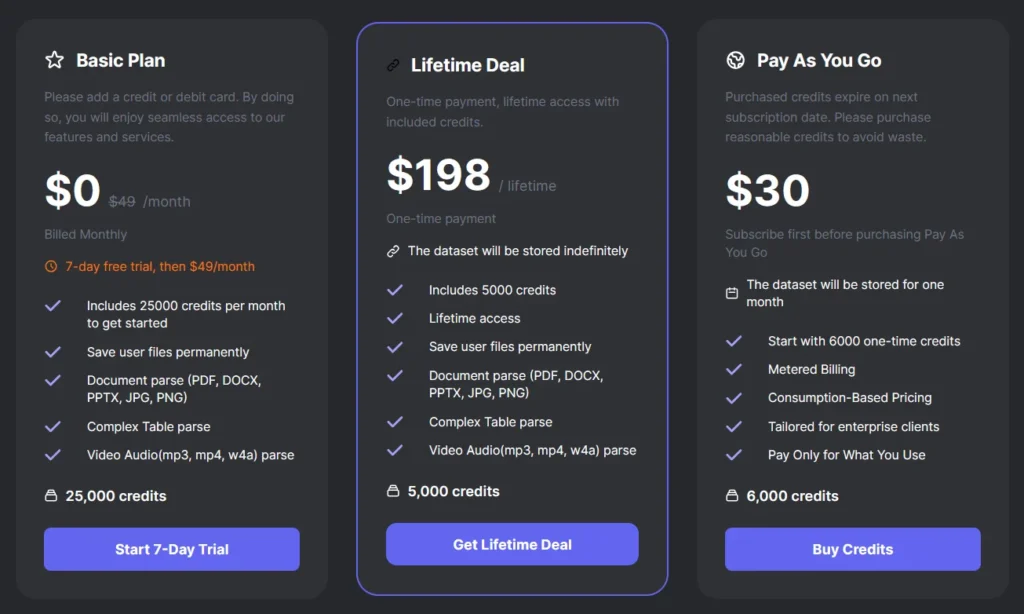
Basic Plan
The free version of UnDatas.io allows users to explore the platform’s advanced unstructured data parsing capabilities through an initial trial period. It provides a comprehensive set of tools to automatically recognize document layouts and categorize tables, images, formulas, and text. While it requires a credit or debit card for activation, the first 7 days are free, allowing for seamless testing of its high-performance processing engine.
This version is best suited for individual developers or researchers who need to test the accuracy of PDF, DOCX, and video/audio parsing before committing to a recurring monthly subscription.
Paid UnDatas Plans
To maintain permanent file storage and access a higher volume of monthly processing power, users must transition to a paid subscription or a one-time purchase.
The UnDatas.io plans are structured as follows:
- Standard Subscription – $49 per month (billed monthly)
Designed for serious creators and data analysts. This plan includes 25,000 credits per month to get started. It features permanent file storage, document parsing for PDF, DOCX, PPTX, and images (JPG, PNG), as well as complex table parsing and video/audio parsing for MP3, MP4, and W4A files. - Lifetime Deal – $198 One-Time Payment
The best value for long-term projects. This one-time purchase provides lifetime access to the platform and includes 5,000 initial credits. Users benefit from indefinite dataset storage and all the parsing features available in the standard plan, including complex layouts and multimedia extraction, without any recurring fees. - Pay As You Go – $30 (Subscription required first)
Tailored for enterprise clients and high-volume users who need flexible, consumption-based pricing. This tier starts with 6,000 one-time credits and utilizes metered billing. It is ideal for those who have irregular parsing needs but require the dataset to be stored for at least one month.
All plans include access to the UnDatas API, allowing for integration with large-scale language models (LLMs) to enhance data processing and extract deeper insights.
Customer Support and Service Quality — UnDatas IO
Support Channels & Accessibility
UnDatas IO provides support mainly via email, where users can reach out to the team for assistance with parsing, API integration, billing, or technical issues.
There is also a contact form on their website to submit inquiries or request a demo, which helps funnel more structured support requests for both prospective and existing customers.
Self-Service Resources
They maintain detailed documentation, covering topics such as API usage, credit model, data parsing capabilities (tables, formulas, layout), and integration examples. This documentation helps customers self-serve many common questions.
UnDatas IO publishes a blog with updates and best practices, which can help users stay informed on new features and optimal workflows.
Their terms of service and privacy policy are readily accessible, offering transparency about data handling, credit consumption, and account usage.
Service Reliability & Trust
- UnDatas IO places emphasis on data security: they publicly highlight secure data transmission in their documentation, which is critical for a platform that processes potentially sensitive documents.
- The credit-based usage model ensures predictability: users can monitor their credit consumption in real-time, and overuse is controlled by credit limits, which reduces risk of unexpected costs.
- Their pricing and service terms are clearly stated, helping customers understand how their usage translates to credit usage and costs, which contributes to service trustworthiness.
Enterprise Support & SLAs
For business or enterprise customers, UnDatas IO offers custom plans that include higher credit volumes, dedicated support, and API access tailored to large-scale document processing needs.
While a formal Service Level Agreement (SLA) is not deeply detailed on the public-facing site, enterprise plans typically allow negotiation of support terms (e.g., response times, higher concurrency) during sales discussions.
The ability to validate and visually inspect parsed data (“glass-box” verification) in UnDatas IO V3 helps enterprises maintain quality control and reduces reliance on support for parsing errors.
Privacy, Compliance & Data Handling
UnDatas IO’s privacy policy explains how user-uploaded data and parsed results are stored, processed, and retained, ensuring users understand how their documents are handled.
They support secure file processing and encryption, which is essential for customers working with sensitive or proprietary documents (e.g., financial or medical data).
Users can reasonably expect that their parsed data (e.g., tables, text) is returned in a structured form (JSON or Markdown), and UnDatas does not use parsed content in a way that compromises user confidentiality, according to available documentation.
Strengths and Potential Challenges
Strengths:
- Robust documentation and API guides: Helps users self-resolve many technical questions.
- Enterprise-ready features: Custom plans, high credit tiers, and parsing validation make it suitable for business-critical operations.
- Transparent credit-based billing: Predictable usage, with clear metrics and limits.
- Secure data handling: Encryption and privacy policies help maintain trust for document-sensitive workflows.
Potential Challenges:
- Lack of real-time support channels: Absence of live chat or phone support may slow down resolution for urgent or complex queries.
- Limited public SLA information: Without a clearly stated service-level guarantee on the website, enterprises may need to negotiate terms.
- Complexity of usage: For non-technical users, setting up API workflows or understanding how credits are consumed could require a learning curve.
UnDatas IO demonstrates a solid level of customer support and service quality with strengths in documentation, enterprise flexibility, and data security. Its support model is well-suited to technical users and businesses that need reliable, scalable document processing. However, users who require more immediate, real-time support or a guaranteed SLA may want to clarify terms during onboarding.
Undatas IO: Pros and Cons
Pros of Undatas IO
- Powerful Data Automation: Undatas IO simplifies complex data workflows by automating the collection, cleaning, and transformation of information, helping teams eliminate repetitive manual tasks.
- No-Code Interface: The platform is designed for accessibility — users can build and manage data pipelines without writing code, making it suitable for both technical and non-technical users.
- Seamless Integrations: Undatas IO connects with multiple databases, APIs, and third-party tools, allowing smooth data exchange across systems for analytics, reporting, or machine learning.
- Scalable for Businesses: Its cloud-based infrastructure supports businesses of all sizes, handling large datasets efficiently while maintaining strong performance and uptime.
- Real-Time Data Processing: The platform enables real-time updates and data synchronization, ensuring users always work with accurate and up-to-date information.
Cons of Undatas IO
- Limited Free Plan: The free plan offers restricted workflow executions and integrations, requiring a paid subscription for advanced automation or higher data volume.
- Learning Curve for Complex Workflows: While beginner-friendly, users managing intricate data pipelines may need time to understand all available functions and optimization techniques.
- Internet Dependence: As a fully cloud-based solution, Undatas IO requires a stable internet connection for building, executing, and monitoring workflows.
Undatas IO provides a robust, scalable, and user-friendly solution for automating and integrating data processes without code. It empowers organizations to streamline analytics and decision-making through automation. However, its limited free tier and reliance on cloud connectivity may pose challenges for users needing extensive customization or offline processing capabilities.
Undatas IO Competitors and Alternatives
In the fast-advancing world of AI for Data Analytics, Undatas IO provides automated insights, streamlined data processing, and user-friendly analytical capabilities designed to help teams work more efficiently with their data. While it offers strong functionality for turning raw information into actionable intelligence, several established platforms deliver similar strengths—ranging from no-code predictive modeling to advanced enterprise-grade analytics. Depending on your organization’s needs, alternatives like Akkio, Obviously AI, DataRobot, and Alteryx may also fit well into your analytical stack.
Akkio
Akkio is a no-code AI analytics platform built for rapid predictive modeling and automation. It focuses on providing an accessible way for teams to run machine learning without technical expertise.
Strengths:
Intuitive interface ideal for beginners and business users;
Fast automated modeling and data preparation;
Integrates easily with common business workflows and tools;
Considerations:
Limited advanced customization for data scientists;
Not designed for extremely large or complex datasets;
Obviously AI
Obviously AI offers a no-code environment for building predictive models quickly, prioritizing automation, simplicity, and explainability.
Strengths:
Very fast model creation and testing;
Automated data cleaning and transformation;
Clear visual explanations of predictions and model decisions;
Considerations:
Suitable mostly for straightforward predictive use cases;
Less support for complex machine-learning pipelines or enterprise governance;
DataRobot
DataRobot is an enterprise AI platform providing full lifecycle automation for machine learning, from data preparation to deployment and continuous monitoring.
Strengths:
Comprehensive AutoML across multiple data types;
Strong support for MLOps, monitoring, and model governance;
High scalability for enterprise environments;
Considerations:
More complex than lightweight analytics tools;
May exceed the needs of small teams or basic analytics projects;
Alteryx
Alteryx is a leading self-service analytics platform combining data preparation, automation, and predictive modeling through a powerful low-code workflow interface.
Strengths:
Exceptional data preparation, blending, and transformation tools;
Wide range of analytic capabilities, including predictive and prescriptive analytics;
Strong adoption across enterprise data teams;
Considerations:
Can feel overwhelming for beginners due to its extensive feature set;
More time-intensive to master compared to simpler no-code AI solutions;
Conclusion for Undatas IO review
Undatas IO stands out as a powerful solution for organizations aiming to streamline data processing, automate complex workflows, and transform unstructured information into structured, analytics-ready formats. As highlighted throughout this Undatas IO Review, the platform’s combination of strong parsing accuracy, flexible integrations, and AI-enhanced capabilities positions it as a versatile tool for both technical and non-technical teams. Its support for diverse file types, robust ETL features, scalable infrastructure, and transparent “glass-box” validation model make it especially valuable for businesses managing large volumes of documents or building data-driven applications.
While Undatas IO is not without limitations—such as a learning curve for advanced workflows and limited real-time support—its overall strengths far outweigh these challenges. The platform offers a reliable, secure, and high-performance environment for data preparation, automation, and analysis, making it well suited for enterprises, analysts, and developers seeking efficient ways to turn raw data into actionable insights. With its growing ecosystem, commitment to accuracy, and focus on usability, Undatas IO continues to solidify its role as a leading contender in the evolving landscape of AI for Data & Analytics.
Undatas IO – Frequently Asked Questions
1. What is Undatas IO?
Undatas IO is a platform focused on delivering data-driven insights, analytics content, and practical guidance on modern data engineering, artificial intelligence, and digital transformation. Articles are designed for both technical and non-technical readers who want to understand how data can drive business outcomes.
2. Who creates the content on Undatas IO?
Content is produced by subject-matter experts, data professionals, researchers, and contributors with hands-on experience in fields such as machine learning, data engineering, cloud computing, and analytics strategy.
3. What topics does Undatas IO cover?
Undatas IO publishes articles on data engineering, AI/ML, business intelligence, cloud technologies, data governance, automation, analytics strategy, and emerging digital trends. Tutorials, explainers, opinion pieces, and deep technical guides are also included.
4. Are the articles peer-reviewed or fact-checked?
Yes. All articles undergo an internal editorial review to ensure clarity, factual accuracy, and relevance. Technical pieces are validated by domain specialists before publication.
5. Is Undatas IO an AI-generated content platform?
No. While Undatas IO may use AI tools to support research, organization, or editing, all articles are authored or overseen by human experts to maintain accuracy, context, and professional quality.
6. Does Undatas IO provide tutorials or hands-on examples?
Many articles include step-by-step guides, code snippets, architecture diagrams, or practical examples when relevant. The goal is to make complex concepts easier to understand and apply.
7. Can I rely on Undatas IO articles for academic or professional work?
Yes, provided that you evaluate the information in context. Articles are fact-checked and written by experienced professionals, but readers should assess how the insights apply to their specific domain, project, or environment.
8. How frequently is new content published?
New articles are typically published on a rolling basis. Frequency can vary based on contributor schedules and the depth of the topics being explored.
9. Can I submit an article or become a contributor?
Undatas IO welcomes high-quality contributions from data practitioners, researchers, and industry specialists. Prospective writers can contact the editorial team with topic proposals or writing samples.
10. Does Undatas IO accept sponsored content?
Sponsored content may be accepted if it meets editorial guidelines, remains transparent, and provides genuine value to readers. Sponsored pieces are clearly labeled to maintain trust and integrity.
11. How does Undatas IO ensure the neutrality of its content?
The editorial team follows strict guidelines to avoid promoting specific vendors, tools, or services unless they are necessary for educational or comparative purposes. Articles focus on best practices, not marketing.
12. Are datasets or tools mentioned in articles publicly accessible?
If an article references public datasets, tools, or repositories, links or instructions are typically provided. Proprietary datasets referenced in case studies are not shared unless permission is explicitly granted.
13. Can I request a topic to be covered?
Yes. Readers can suggest topics, ask for clarifications on existing articles, or recommend areas where they’d like more in-depth coverage. Requests help shape future editorial priorities.
14. Does Undatas IO offer consulting, courses, or paid services?
Undatas IO primarily focuses on publishing free, high-quality content. If additional services become available—such as training, workshops, or consulting—they will be announced on the official platform.
15. How can I stay updated with new articles?
Readers can subscribe to the newsletter, follow the platform on social channels, or enable notifications (where available) to receive alerts about new content and updates.